Season 1
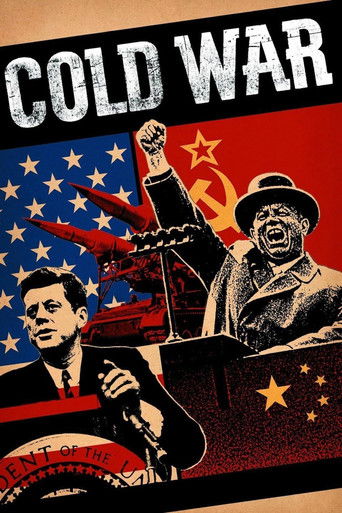
Cold War
Episódios
Comrades (1917-1945)
Despite their ideological differences, the United States and the Soviet Union become allies in the wars against Germany.
★ 3.5 · 1 votosIron Curtain (1945–1947)
Stalin begins to spread communism across Europe after the war ends, and tension grows between the United States and the Soviet Union.
★ 3.5 · 1 votosMarshall Plan (1947–1952)
The United States offers assistance to countries that reject communism after Great Britain halts aid to Turkey and Greece.
★ 3.5 · 1 votosBerlin (1948–1949)
Berlin is divided into two separate cities, and Europe itself splits as the countries align themselves with the opposing major powers.
★ 3.5 · 1 votosKorea (1949–1953)
A Chinese civil war between the factions of Mao Zedong and Chiang Kai-Shek brings the armed forces of the United States onto the battlefield to oppose communism.
★ 3.5 · 1 votosReds (1948–1953)
A look at the period in which Stalin securely dominated eastern Europe, China embraced communism, and anti-communist hysteria spread in the United States.
★ 3.5 · 1 votosAfter Stalin (1953–1956)
Stalin's death brings hope that tensions will ease between the Soviet Union and the United States, and Nikita Khrushchev becomes the new Soviet Leader.
★ 3.5 · 1 votosSputnik (1949–1961)
The Soviet Union launches its first satellite into orbit while the United States' own space program lags behind.
★ 3.5 · 1 votosThe Wall (1958–1963)
The Soviet Union solves the problem of people leaving East Germany to the free West by stopping open transit and building a secured ring around West Berlin.
★ 3.5 · 1 votosCuba (1959–1962)
President Kennedy confronts Kruschev when the Soviet Union begins to deploy nuclear missiles in Cuba
★ 3.5 · 1 votosVietnam (1954–1968)
The United States continues its containment of communism by becoming involved in Vietnam's ongoing struggle, leading to enormous public disapproval of the policy.
★ 3.5 · 1 votosMAD (1960–1972)
A look at how technology shaped the politics of the Cold War era, including the United States' Mutual Assured Destruction strategy and the introduction of missiles with multiple payloads.
★ 3.5 · 1 votosMake Love Not War (The 60s)
An examination of the effects of the Cold War upon the populace, including civil rights movements and protests that led to policy changes.
★ 3.5 · 1 votosRed Spring (The 60s)
The Soviet Union continues its aggressive European policy by invading Czechoslovakia and crushing the Prague Spring Revolution.
★ 3.5 · 1 votosChina (1949–1972)
The history of communism in China, from Mao Tse-tung's victory to President Nixon's trip to China in 1972.
★ 3.5 · 1 votosDetente (1969–1975)
A look at the era of detente that resulted in cooperation and exchange between the United States and the Soviet Union.
★ 3.5 · 1 votosGood Guys, Bad Guys (1967–1978)
An examination of how the major powers fought by proxy in different areas of the world throughout the era.
★ 3.5 · 1 votosBackyard (1954–1990)
The United States utilizes different ways to fight the spread of communism in its own hemisphere, from Guatamala to Grenada.
★ 3.5 · 1 votosFreeze (1977–1981)
Unrest in Eastern Europe and the Oil Crisis threatens to undermine the progress made by detente.
★ 3.5 · 1 votosSoldiers of God (1975–1988)
An examination of the effects of religious fundamentalism upon the United States and the Soviet Union's foreign policies.
★ 3.5 · 1 votosSpies (1944–1994)
A look at the hidden front of the Cold War involving subterfuge and secret intelligence gathering.
★ 3.5 · 1 votosStar Wars (1981–1988)
The Soviet Union's economy falters as it struggles to keep up in the arms and technology race.
★ 3.5 · 1 votosThe Wall Comes Down (1989)
The Soviet Union loses its grip on Eastern Europe as the Berlin Wall comes down and the Cold War comes to an end.
★ 4.0 · 1 votosConclusions (1989–1991)
The Cold War era comes to an end as the Soviet Union's empire falls and new policies are implemented by Mikhail Gorbachev and Boris Yeltsin.
★ 3.5 · 1 votosFotos